by
by Winning all four major championships represents tennis’s ultimate individual accomplishment.
Completing this feat separates legends from great players across more than a century of competition.
Age-based records reveal when players reach their peak dominance.
Younger completion ages typically signal longer careers at the top and greater potential for total major accumulation.
The 2026 Australian Open marked a historic moment when the youngest career grand slam winners in men’s tennis rankings were permanently altered.
An 88-year record fell, establishing new benchmarks for future champions.
Top 10 Youngest Career Grand Slam Winners in Men’s Tennis 2026
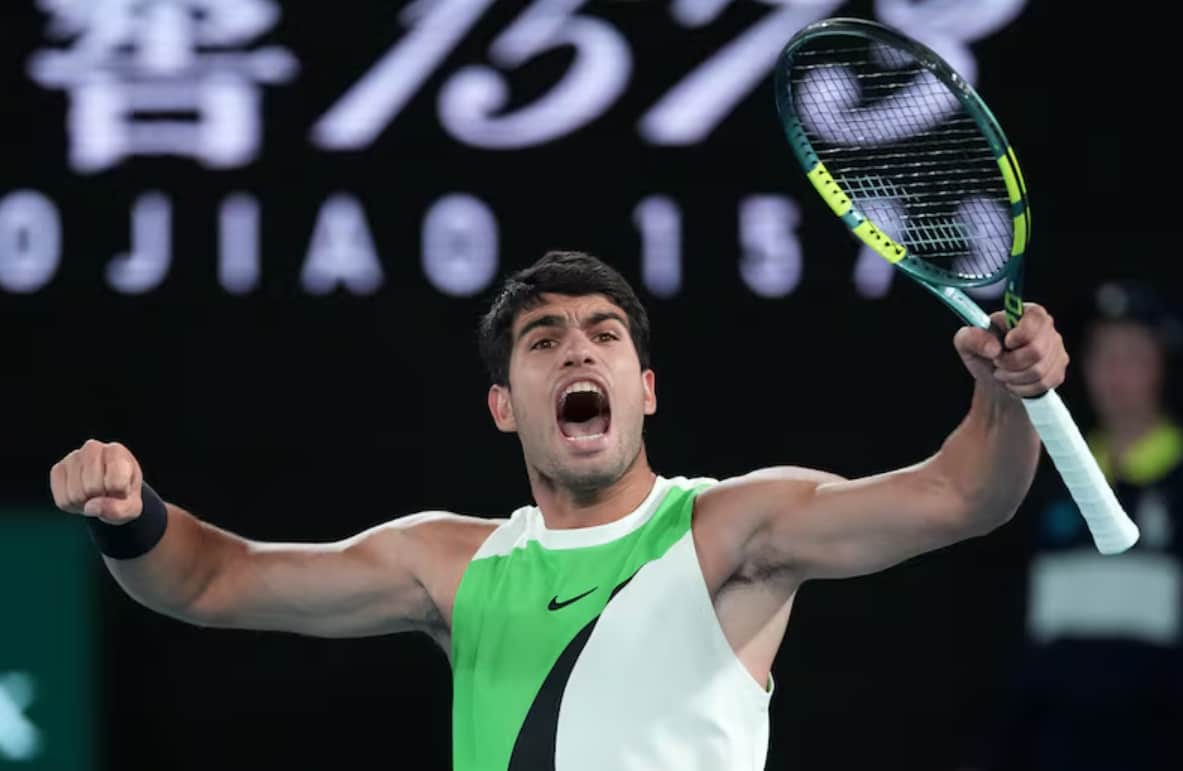
Top 10 Youngest Players to Complete a Career Grand Slam in Men’s Tennis 2026
| Rank | Player | Country | Age at Completion | Tournament |
|---|---|---|---|---|
| 1 | Carlos Alcaraz | Spain | 22y 272d | Australian Open 2026 |
| 2 | Don Budge | USA | 22y 363d | French Open 1938 |
| 3 | Rod Laver | Australia | 24y 32d | US Nationals 1962 |
| 4 | Rafael Nadal | Spain | 24y 101d | US Open 2010 |
| 5 | Fred Perry | Great Britain | 26y 15d | French Championship 1935 |
| 6 | Roy Emerson | Australia | 27y 243d | Wimbledon 1964 |
| 7 | Roger Federer | Switzerland | 27y 303d | French Open 2009 |
| 8 | Novak Djokovic | Serbia | 29y 15d | French Open 2016 |
| 9 | Andre Agassi | USA | 29y | French Open 1999 |
| 10 | Rod Laver (Calendar GS) | Australia | — | 1969 |
Top 10 Youngest Career Grand Slam Winners in Men’s Tennis
-
1. Carlos Alcaraz (Spain)
Alcaraz reached his career Grand Slam age milestone at 22 years and 272 days following his 2026 Australian Open victory. He defeated Novak Djokovic in the final to secure his first Melbourne title.
His major collection includes the US Open 2022, Wimbledon 2023 and 2024, and the French Open 2024 and 2025. The Australian Open completed his set at seven total majors.
This achievement broke Don Budge’s 1938 record by 91 days. His pace to seven titles surpasses all previous champions, creating a massive gap over peers like Jannik Sinner, who currently sits at zero majors despite similar age and ranking.
-
2. Don Budge (USA)
Budge held the age record for 88 years after completing his set at 22 years and 363 days in 1938. He became the second youngest career grand slam winner following Alcaraz’s 2026 breakthrough.
The French Open victory completed his collection and coincided with his Calendar Year Grand Slam. Budge swept all four majors in a single season, a feat only matched by Rod Laver since.
He won six Grand Slam singles titles before transitioning to professional circuits. His pre-war dominance established standards that lasted nearly a century.
-
3. Rod Laver (Australia)
Laver completed his set at 24 years and 32 days in 1962 when he won the US Nationals. He would later become the only player on the career Grand Slam list to achieve the feat twice.
His second completion came in 1969 during the Open Era, adding historical weight to the accomplishment. Laver finished with 11 major singles titles across both amateur and professional competition.
His versatility on all surfaces and two Calendar Grand Slams place him among the sport’s most complete players.
-
4. Rafael Nadal (Spain)
Nadal completed his collection at 24 years and 101 days when he won the 2010 US Open. The title proved his dominance extended beyond clay courts.
How many Grand Slams did Nadal have at 22 totaled four majors—three French Opens and one Wimbledon. By age 24, he had accumulated nine Grand Slam titles.
He retired with 22 majors, including 14 French Open championships. His clay-court mastery at Roland Garros remains unmatched in tennis history.
-
5. Fred Perry (Great Britain)
Perry completed his set at 26 years and 15 days in 1935 after winning the French Championship. He dominated mid-1930s tennis and became Britain’s greatest male champion.
Perry accumulated eight Grand Slam singles titles during the pre-Open Era. His all-surface consistency distinguished him from contemporaries.
Wimbledon honored his legacy by naming the Centre Court player facilities after him. He remains a British sporting icon decades after retirement.
-
6. Roy Emerson (Australia)
Emerson reached his career Grand Slam age benchmark at 27 years and 243 days following his 1964 Wimbledon victory. He collected 12 Grand Slam singles titles, primarily during the amateur era.
His major record stood until Pete Sampras surpassed it in 2000. Emerson’s physical conditioning and consistency made him Australia’s dominant player through the 1960s.
He won at least two titles at every major, proving his surface adaptability.
-
7. Roger Federer (Switzerland)
Federer completed his collection at 27 years and 303 days by winning the 2009 French Open. He had lost four previous Roland Garros finals before breaking through.
The victory allowed him to surpass Pete Sampras’s all-time major record. Federer retired with 20 Grand Slam singles titles.
His elegant style and career longevity made him one of the most admired athletes across all sports.
-
8. Novak Djokovic (Serbia)
Djokovic completed his set at 29 years and 15 days when he captured the 2016 French Open. Roland Garros was the final major missing from his resume after multiple close calls.
He holds the all-time men’s record with 24 Grand Slam singles titles. His durability and consistency across surfaces define his legacy.
Djokovic continues competing at the elite level and adding to his historic totals.
-
9. Andre Agassi (USA)
Agassi completed his collection in 1999 by winning the French Open at approximately 29 years old. He became the first American man in the Open Era to achieve this milestone.
Agassi has eight Grand Slams numbered eight singles titles across all four majors. His comeback from rankings obscurity to complete the set remains a tennis legend.
He competed at the highest level into his mid-30s and is celebrated for his baseline power and return skills.
-
10. Rod Laver (Calendar GS)
Laver’s 1969 Calendar Year Grand Slam during the Open Era holds greater historical significance than his 1962 achievement. No man has matched this accomplishment in over five decades.
His 1969 season included victories against professional competition at all four majors. The feat cemented his place among the sport’s all-time greats.
His legacy as the only two-time Calendar Grand Slam winner in men’s tennis remains secure.
Why You Should Focus on Alcaraz’s Record?
- Youngest Completion in History: Alcaraz shattered Don Budge’s 1938 record by 91 days. Completing the career Grand Slam at 22 years and 272 days establishes a benchmark that may stand for decades.
- Rapid Accumulation of Major Titles: Seven Grand Slam titles by age 22 represents unprecedented efficiency in modern tennis. Previous champions needed significantly more time to reach comparable totals.
- Modern Competitive Landscape: Today’s professional tennis features unprecedented depth and physical demands. Completing a career Grand Slam in 2026 requires defeating multiple all-time champions still competing at peak levels.
- Future Record Ceiling: Alcaraz could potentially compete at the elite level for 15 more years. His age advantage positions him as the most realistic candidate to challenge Djokovic’s 24-major record.
Conclusion: Youngest Career Grand Slam Winners in Men’s Tennis 2026
The youngest career grand slam winners in men’s tennis demonstrate how age benchmarks evolve in professional sports. Alcaraz’s 2026 achievement rewrote a standard that existed since the pre-war era.
Historical progression shows modern training methods enable earlier peak performance. Completing the career Grand Slam before age 23 was previously considered virtually impossible.
Differences between men’s and women’s milestones remain significant. The youngest career Grand Slam winner woman was Martina Hingis at 18, while the youngest career Grand Slam winner female shows that women’s tennis produces earlier completion ages historically.
Key takeaways:
- Alcaraz set the record at 22 years, 272 days in 2026
- Only nine men have completed all four majors in over 100 years
- Younger completion ages strongly correlate with higher career major totals
- Women’s tennis historically sees career Grand Slam completion at younger ages
Also Check: